



Governor Makinde, The Politics Of Critique And The Federal Reforms On Exchange Rate Unification And Subsidy Removal | By Aderogba Adebayo
To interrogate public policy in a democracy is both necessary and inevitable. Yet in a polity as textured as ours, criticism rarely travels alone. It is often accompanied by context, ambition, and alignment.
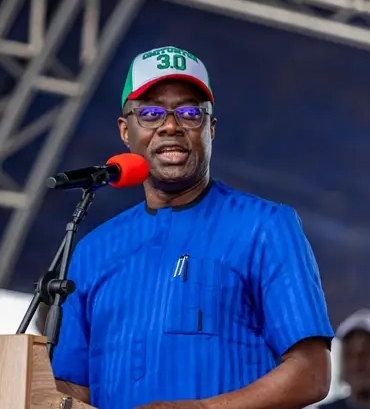
The recent and rather caustic condemnation by Governor Seyi Makinde of the Federal Government’s twin reforms: the removal of fuel subsidy and the unification of the exchange rate, must therefore be read on two registers: as an expression of genuine concern over citizen welfare, and as a political articulation shaped by positioning.
It bears stating that Governor Makinde is not a neutral observer in the 2027 conversation. He is widely regarded and has presented himself as the presidential candidate of the African Peoples Movement, APM. In that capacity, every pronouncement on national economic direction carries, in addition to its policy content, an electoral valence. To criticize the reforms of the Tinubu administration is, for him, both governance commentary and political differentiation.
The Substance of the Criticism
The Governor’s objections have been consistent. He has argued that the reforms were introduced without adequate cushioning, that their immediate effect has been to deepen hardship, and that the inflationary shock from fuel and FX adjustments has outpaced the capacity of households and businesses to adjust.
These are not frivolous concerns. The pass-through effect of subsidy removal on transport, food, and services was immediate and severe. Inflation eroded purchasing power. For a governor managing a state of over 7 million people, that pressure is felt daily in markets, in motor parks, and in civil service payrolls.
The Paradox of Benefit
Yet here lies the contradiction that politics rarely admits. Since the removal of subsidy and the deregulation of FX, FAAC allocations to states have risen markedly. Oyo State has been a direct beneficiary. The increased inflows would have funded road projects, health insurance expansion, education interventions, and wage awards to public servants, if well utilized by the Oyo state government led by Seyi Makinde but I have my reservations and doubt on this.
Thus, the Oyo government is simultaneously a critic of the reform’s social cost and a beneficiary of its fiscal dividend. This is not only hypocrisy. It is the structural reality of Nigerian federalism: states receive more, but they also spend more in an inflationary environment. The political utility, however, is that one can take the allocation and still denounce the policy that produced it. This is absolute hypocrazy!
Has the Reform Failed?
A policy is not measured only by its first 12–18 months of pain, but by whether it corrects structural distortions and creates fiscal space.
Judged against the narrow metric of immediate affordability, the reforms have inflicted pain. Judged against the broader metric of structural correction, they have ended two of the most distortionary regimes in our fiscal history as a nation:
1. Fiscal Rebalancing: The subsidy regime consumed upwards of ₦4 trillion annually with minimal transparency. Its removal has restored revenue to the Federation Account, creating space for capital expenditure rather than consumption.
2. Exchange-Rate Rationalization: The unification of FX windows has reduced arbitrage, improved transparency, and begun to restore confidence among portfolio and direct investors. Volatility persists, but the multiplicity that crippled planning has been addressed.
To declare the reform a “failure” at this stage is to mistake transition for destination. The more precise assessment is that the reform is incomplete. Its durability will depend on what is done with the savings: targeted social protection, mass transit migration to CNG, agricultural productivity, and infrastructure that lowers the cost of doing business. To say the least, the President Bola Ahmed Tinubu led federal Government is doing well in terms of embarking on sevearal ambitious infrastructural development across the length and breadth of Nigeria.
Implications for the Tinubu Administration’s Growth Agenda
For President Bola Ahmed Tinubu’s administration, the reforms are a bet that short-term pain will yield long-term stability. If inflation moderates, if FX remains stable, if savings are channeled into infrastructure and human capital, then the fiscal space created can support sustained growth. If cushioning measures lag and production does not respond, the social costs will continue to dominate the political conversation.
These reforms are the cornerstone of a long-term growth strategy. The logic is straightforward: you cannot build a productive economy while subsidizing consumption and distorting prices.
The fiscal space created is intended to finance infrastructure, human capital, and industrial policy. The FX adjustment is intended to attract investment and formalize the economy. The political risk is that the benefits are medium-term, while the costs are immediate and visceral.
This is precisely why the critique from figures like Governor Makinde resonates. As a prospective presidential contender, he is occupying the space of empathy and welfare. He is framing himself as the leader who would manage reform with a “human face.” That is legitimate politics. What an irony?
In summary, Governor Makinde’s condemnation reflects genuine concern about affordability and sequencing — concerns shared by many Nigerians. At the same time, Oyo State, like other states, is a direct beneficiary of the increased revenue the reforms have generated.
His condemnation cannot be divorced from its political colouration. As the standard-bearer of APM, his role requires him to offer an alternative narrative to the Tinubu administration. That he does so while Oyo benefits from higher allocations is a reflection of politics, not necessarily contradiction.
The reforms themselves have not failed in their objective to correct fiscal distortions. Whether they succeed in delivering sustainable growth will depend less on the rhetoric around them and more on the competence with which the savings are deployed.
The measure of sustainability for the Tinubu administration will be whether the fiscal savings translate into visible improvements in living standards within this term. In the end, Nigerians will judge not by communiques, but by outcomes: the price of garri, the cost of transport, the state of hospitals, and the availability of jobs. These postive signs are obvious and to say the least, the Federal government is moving in the right direction, baseless criticism not withstanding, its just a question of time. Time will really tell.
Until then, criticism will remain both a civic duty and a campaign strategy.
About the Author: Comrade Adebayo Taofik Aderogba, mni, is a unionist in the food, beverage, and tobacco industry, with professional expertise in logistics and supply chains. He is also a policy research and public affairs analyst, an advocate for good governance, and a chieftain of the Oyo APC. He writes from Ward 12, Ibadan North Federal Constituency, Oyo State, Nigeria.
https://shorturl.fm/SmnpA
unlocker.ai – The Ultimate AI Tool for Bypassing Restrictions and Unlocking Content Seamlessly!
This post really resonated with me today.