



AI, Education and Development: The Remi Oseni Model || By Timilehin Kolade
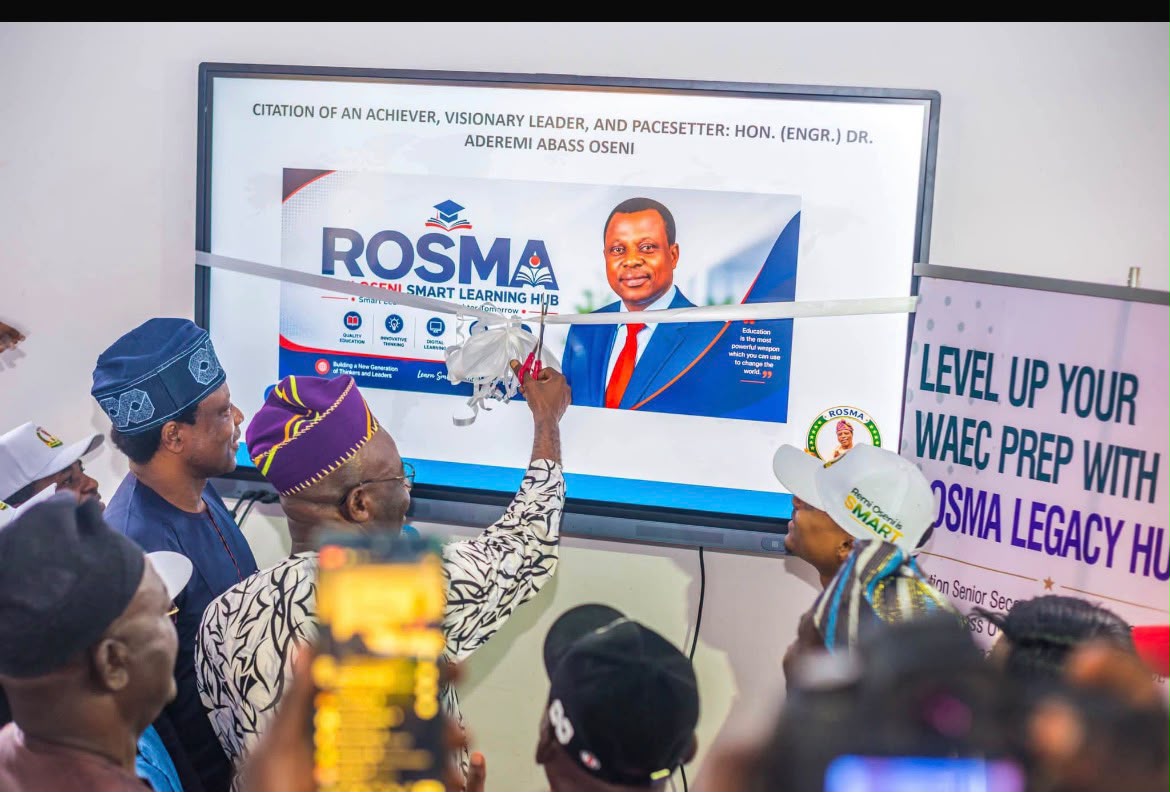
Politics is often judged by the intensity of electoral competition, yet its noblest expression lies in its capacity to transform lives. The most enduring political legacy is not the rhetoric of campaigns but the institutions that expand opportunities, cultivate human potential, and prepare society for the future. This is the prism through which Hon. Remi Oseni’s Remi Oseni Smart Learning Intervention (ROSMA) should be understood.
The commissioning of the ROSMA Smart Learning Hub is more than an educational initiative. It is a developmental intervention that brings together three indispensable pillars of national progress: artificial intelligence, quality education, and human capital development. While the immediate objective is to prepare students in Oyo South for the West African Senior School Certificate Examination (WAEC), the broader significance lies in equipping a generation with the digital competencies required in an AI-driven world.
Artificial intelligence is no longer a futuristic concept; it is reshaping economies, governance, education, healthcare, commerce, and the nature of work itself. Nations that expose their young people to AI and digital technologies today are laying the foundation for innovation, competitiveness, and economic prosperity tomorrow. Consequently, a smart learning hub is not merely a physical facility—it is an investment in the future workforce and leadership of society.
Education remains the most reliable instrument for sustainable development because it enlarges human capabilities. Development economist Amartya Sen argues that development should be understood as the expansion of people’s freedoms and capabilities rather than the accumulation of material wealth alone. In the same vein, investments in technology-enabled education empower young people not only to pass examinations but also to think critically, solve problems, create innovations, and participate meaningfully in the global knowledge economy.
The ROSMA initiative resonates with this philosophy. By integrating AI-supported learning with academic preparation, it moves beyond conventional educational support to foster digital literacy and technological confidence. Students who benefit from such exposure will not merely become successful examination candidates; they will be better prepared for careers and opportunities emerging from the Fourth Industrial Revolution.
This is where the Remi Oseni Model distinguishes itself. It represents a politics of development rather than a politics of patronage. Primitive politics often revolves around temporary gestures designed to secure immediate political loyalty. Developmental politics, however, prioritizes investments whose benefits extend beyond electoral cycles. It builds capacity instead of dependency, creates opportunities instead of expectations, and leaves institutions rather than fleeting memories.
The distinction is important. Roads, bridges, and other physical infrastructure remain essential to development, but the infrastructure of the mind is equally indispensable. Societies advance when they invest simultaneously in physical assets and intellectual capital. A smart learning hub therefore complements traditional infrastructure by producing educated, technologically competent, and globally competitive citizens.
Hon. Remi Oseni’s intervention also broadens the understanding of democratic representation. Effective representation is not limited to legislative debates or constituency projects measured solely in concrete and steel. It also involves anticipating future societal needs and responding with innovative solutions. At a time when artificial intelligence is transforming every sector of human endeavour, preparing young people to navigate this new reality is itself an act of visionary representation.
The developmental implications are profound. Human capital has become the defining resource of modern economies. Countries that consistently invest in education, technology, and innovation outperform those that rely exclusively on natural resources or short-term political calculations. By exposing students to AI-enabled learning environments, the ROSMA initiative contributes to building a generation capable of driving economic growth, entrepreneurship, research, and national competitiveness.
Perhaps the greatest strength of the initiative is its legacy value. Political achievements are often measured by what is visible in the present, yet history remembers leaders by the institutions they leave behind. A smart learning hub that continues to nurture students year after year represents an enduring investment whose impact will be felt across generations. Every student empowered through technology becomes a potential innovator, employer, researcher, or public servant whose contributions will multiply the value of the original investment.
Ultimately, the intersection of AI, education, and development defines the future of governance itself. The politics of the twenty-first century must move beyond the distribution of immediate benefits towards the creation of enduring opportunities. It must produce citizens who are equipped not merely to survive but to compete, innovate, and lead in an increasingly digital world.
The Remi Oseni Model offers an instructive example of this philosophy in practice. Through the ROSMA Smart Learning Intervention, politics becomes an instrument for expanding human capabilities, strengthening educational outcomes, and positioning Oyo South within the emerging knowledge economy. It is a reminder that the highest purpose of political leadership is not simply to win elections but to prepare the next generation for a future they can confidently shape.
As Nigeria seeks pathways to sustainable development, initiatives such as ROSMA demonstrate that the most enduring political investments are those made in the minds of young people. In the age of artificial intelligence, building human capital is no longer optional—it is the defining measure of developmental leadership.
https://shorturl.fm/87RxS
https://shorturl.fm/K6WGx
https://shorturl.fm/hwitm
I’ve read some good stuff here. Definitely value bookmarking for revisiting. I wonder how a lot effort you put to create this kind of fantastic informative website.