




Oriire Kidnappings: Alao-Akala’s State Police Advocacy Gains Momentum as FG Nears Constitutional Framework

By Ajadi Isaac
The renewed call for the establishment of State Police in Nigeria received a significant boost this week following revelations from the Presidency that the constitutional framework for its implementation is nearing completion, a development that has been welcomed by stakeholders advocating for far-reaching security reforms across the country.
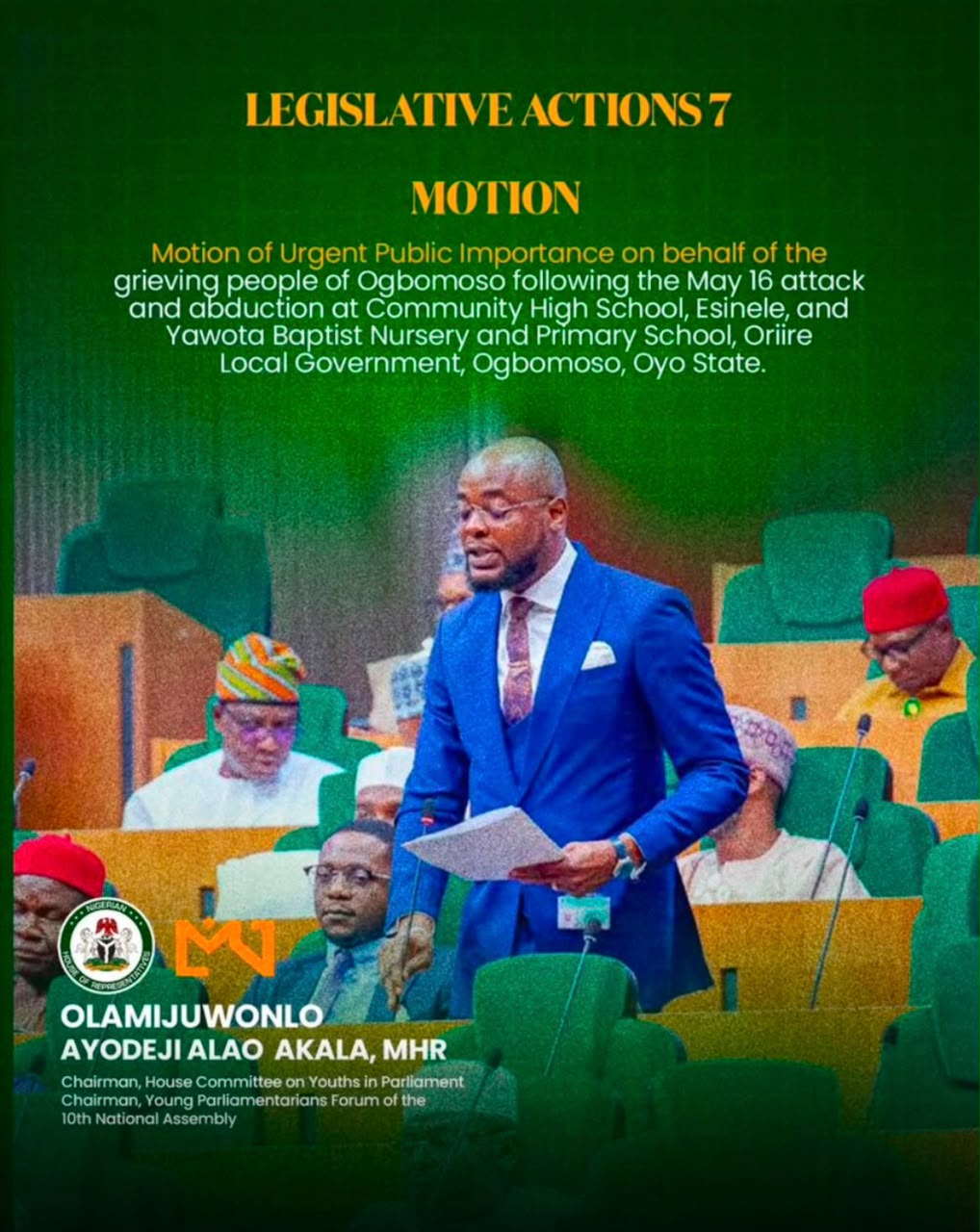
The progress was disclosed shortly after the Member representing Ogbomoso North, Ogbomoso South and Oriire Federal Constituency in the House of Representatives, Hon. Olamijuwonlo Alao-Akala, moved a Motion of Urgent Public Importance on the worsening security situation in Oriire Local Government Area of Oyo State.
The lawmaker had drawn the attention of the House to the May 16 abduction of pupils and teachers from Community High School, Esiele, and Yawota Baptist Nursery and Primary School in Oriire Local Government, as well as the gruesome murder of a Mathematics teacher, Mr. Michael Oyedokun, who was reportedly beheaded by his captors while in captivity.
Speaking during plenary, Alao-Akala described the incident as a tragic reminder of the urgent need to strengthen Nigeria’s security architecture through structural reforms capable of delivering effective grassroots policing and intelligence gathering.
The motion, which resonated strongly among lawmakers, called for intensified rescue efforts for the remaining victims, the establishment of a permanent military operational base in Oriire, and the decentralization of the nation’s security system through State Police, Local Government policing units, and improved local intelligence networks.
Barely twenty-four hours after the motion was presented, the Presidency announced that substantial progress had been made toward the creation of State Police.
At a high-level meeting convened by the Presidency, the Chief of Staff to the President, Rt. Hon. Femi Gbajabiamila, disclosed that work on the constitutional and legal framework required for State Police had advanced considerably and was approaching a critical stage.
According to him, there is now broad national consensus on the necessity of State Police, with stakeholders across the federation increasingly recognizing the limitations of the current centralized policing structure in addressing contemporary security challenges.
Political observers have described the development as a major validation of Alao-Akala’s consistent advocacy for decentralized security administration.
For years, the federal lawmaker has maintained that security is most effective when driven by local knowledge, community intelligence, and rapid response mechanisms that understand the peculiar realities of individual communities.
His position was reinforced in the wake of the Oriire school abductions, where he argued that locally coordinated policing structures, supported by state and local authorities, would significantly improve intelligence gathering, crime prevention, and emergency response capabilities.
While commending the Federal Government’s recent deployment of 1,000 armed Forest Guards to Oriire Local Government, Alao-Akala insisted that sustainable security would require broader institutional reforms capable of addressing criminal activities around the Old Oyo National Park and other vulnerable areas.
The lawmaker expressed optimism that the National Assembly would conclude the necessary constitutional amendments to pave the way for the establishment of State Police and other complementary security institutions.
Analysts believe that the growing momentum behind the initiative reflects an emerging national consensus that Nigeria’s security challenges require innovative and decentralized solutions.
For the people of Ogbomoso and the families still awaiting the safe return of their loved ones, the conversation on State Police has moved beyond political debate to an urgent matter of public safety and national survival.
As efforts continue to secure the release of the abducted victims, many observers view the latest developments from the Presidency as a significant step toward the comprehensive security reforms being championed by Hon. Olamijuwonlo Alao-Akala and other proponents of community-based policing across the country.
https://shorturl.fm/BjiLY