


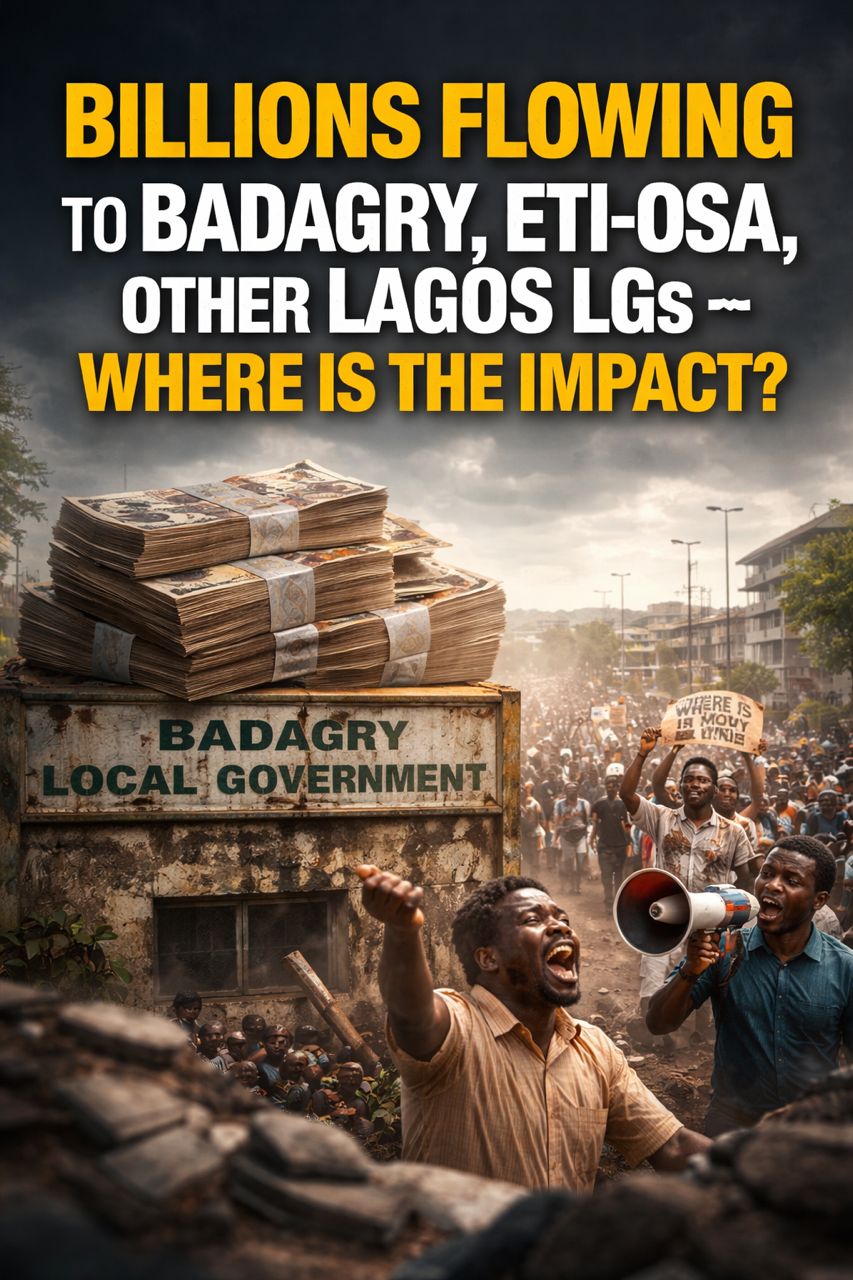
JAAC Records Show Billions to Badagry, Eti-Osa, Other Lagos LGs — But Where Is the Impact?
For decades, Nigeria’s local governments, the so-called “third tier” were widely dismissed as extensions of state power, constrained by the joint account system and stripped of real autonomy.
Then came reform. Direct allocations from the Federation Account began flowing straight into local government coffers, promising a new era of grassroots development and accountability.
On paper, it was a breakthrough.
In practice, it is raising uncomfortable questions.
A Tale of Two Realities in Lagos
Across Lagos, the impact of direct allocation is uneven, almost contradictory.
In some councils like Kosofe, Agboyi Ketu, etc there is visible evidence of progress. Roads are being rehabilitated. Health centres upgraded. Schools improved. A new culture of public scrutiny, driven by digital activists like Scott Iguma and data transparency has begun to shape performance. Citizens can now track inflows and demand results.
But this is only one side of the story.
Where the Numbers Don’t Match Reality
In local governments like Badagry, the narrative is harder to reconcile.
Despite its historical and economic significance as a major gateway for cross-border trade, residents continue to grapple with deteriorating healthcare facilities, weak infrastructure, and limited social investment.
Frustration is no longer quiet. It is public,and growing.
In July 2025, tensions came to a head when residents in Ologbo/Lusada axis (adjust if needed) openly called out the Local Government Chairman, Hon. Olusegun Onilude, over the controversial state of a primary healthcare centre that had reportedly received attention on paper but remained in poor condition in reality.
The incident was more than a local dispute, it became a symbol of a deeper governance question.
If a healthcare centre can still fall into disrepair under a system receiving hundreds of millions monthly, then the issue is not just funding.
It is accountability.
Where is our money?
What the JAAC Data Reveals
An analysis of JAAC (Joint Allocation Account Committee) schedules from 2024 through September 2025 provides critical insight into why this question is gaining momentum.
Badagry Local Government Fiscal Snapshot:
• Monthly Average Allocation: ~₦305.6 million
• Estimated Annual Allocation: ~₦3.66 billion
• Growth Trend: From ~₦211 million in January 2024 to over ₦512 million by September.
These figures point to a clear reality:
Badagry is not underfunded.
Yet, across the local government, basic services tell a different story. Primary healthcare centres remain in poor condition. Infrastructure gaps persist. For many residents, the scale of public spending is simply not reflected in their daily lives.
This disconnect, between inflow and impact—is at the heart of the controversy.
Beyond Badagry: A Systemic Question
Direct allocation was designed to strengthen local governance—bringing decision-making closer to the people and enabling faster, more responsive development.
Instead, in many communities, it has done something else:
it has made the gaps more obvious.
With financial inflows now easier to track, citizens can see what is coming in. What they cannot always see is how it is being used.
This is the paradox.
Local government autonomy was meant to deepen democracy. But without transparency, accountability, and measurable outcomes, autonomy risks becoming something else entirely—a system where more money flows in, but little visibly changes.
The Question That Won’t Go Away
Across Badagry, Eti-Osa, and other parts of Lagos, one question continues to echo:
If the money is there…
where is the impact?
https://shorturl.fm/KjyQ4